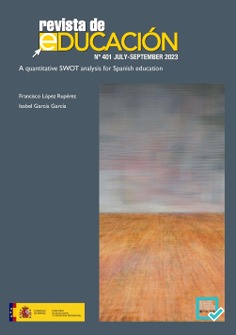

A quantitative SWOT analysis for Spanish education
This paper aims to contribute to the strategic analysis of the Spanish system with the ultimate goal of helping to guide the improvement of its educational policy. In the field of education, SWOT analyses have so far focused on university institutions and, to a lesser extent, on schools. However, available SWOT analyses of national education systems are scarce and deficient. Two procedures have been used: a qualitative SWOT analysis (Strengths, Weaknesses, Opportunities and Threats) and the subsequent application of the quantitative technique of the Analytic Hierarchy Process (AHP). The preparation of the SWOT matrix has been carried out at two hierarchical levels: that of the sub-factors and that of the indicators. For internal factors (WS), resources, processes/policies (governance) and results have been taken as the basis. For external factors (TO), the PESTEL model has been adopted, limited to the political, socio-economic and technological categories. The specification of the sub-factors in indicators has been supported by the results of a significant number of national and international research and statistics. The subsequent application of the AHP technique has identified relative priorities based from comparisons within the multilevel hierarchical structures. The initial 38 SWOT indicators have been reduced to 17, of which, with a global priority of more than 0.050 and a low consistency ratio, the following stand out: intergenerational transmission of the educational level of parents, new technological tools for improving performance, Next Generation funds, lack of a basic political agreement, and low level of excellence. Based on the results, the discussion focused on analysing the strategies of the maxO-minW and minTmaxO types and on formulating evidence-based recommendations aimed at implementing the resulting strategies.
- Idioma
- Castellano
- Editorial
- Instituto Nacional de Evaluación Educativa
- EAN
- 9789200255137
- Edición
- 1
- Fecha publicación
- 22-12-2023
Libros relacionados
Mos. Recurso para la educación musical. ESO y bachillerato
La fuga de talentos

Boletín de Seguridad de la Información nº 14
8 de marzo de 2017. Día Internacional de la Mujer. "Educar en la igualdad y el respeto es educar contra la violencia". B. Franklin
Plan provincial de formación del profesorado. Curso 1991-1992 (Cuenca)
Boletín de educación educainee nº 10. Factores determinantes del rendimiento educativo internacional
La aventura de cantar
La educación y su entorno
Revista de Educación nº 407. January-March 2025
Lengua extranjera II: inglés. Materiales didácticos. Bachillerato